| PRESIDENTS
of the ILLUMINATING ENGINEERING SOCIETY |

|
The Illuminating Engineering Society was
founded in 1908 following an informal meeting arranged
by Leon Gaster, editor of The Illuminating Engineer, which had been
established the year before. The Society continued
until 1977 when it merged with the Institution of
Heating and Ventilating Engineers to form The
Chartered Institution of Building Services. (It was a
few years later that Engineers was added to the
title). |
|
The
centenary of the founding of IES has now passed,
but the intention is still to
provide background information on its
Presidents. Listing all their names on this
website is to encourage contributions from as
wide an audience as possible.
|
| The IES had a total of 55 Presidents. Apart from the early period, the majority served for a term of one year. J W T Walsh was the only member to be elected twice, in 1929 and again in 1947. |
The Presidents named in the list whose names appear in colour are
visitable hyperlinks. Place your cursor over the name to use the link
and display biographical information about that person.
| Prof Silvanus T Thompson D.Sc RS 1909 - 1913 | Clement W Sully
1933 |
| Sir WilliamBennett 1914 - 1916 | H Hepworth Thompson 1934 |
| Alexander Pelham Trotter BA
1917 - 1920 'Elektro' Slide Rules  |
Alfred W Beuttell
Biography of his life,
patents
1935 & companies  |
| Sir John Herbert Parsons CBE FRS 1921 - 1923 | A Cunnington BSc 1936 |
| Sir Duncan Wilson CVO CBE 1927 | S English DSc 1937 |
| Sir Clifford Paterson OBE FRS DSc 1928 - 1929 | Percy Good CBE 1938 |
| J W T Walsh MA DSc 1929 | F C Smith 1939 |
| The Rt Hon The Earl of Mount Edgcumbe 1930 | Prof J T MacGregor-Morris DSc 1940 |
| Sir Francis Goodenough CBE 1931 | W Jones MSc 1941 |
| Haydn T Harrison 1932 | R O Ackerley 1942 |
| H Buckley DSc 1943 | Walter R Stevens 1953 |
| E Stroud 1944 | E C Lennox 1954 |
| H C Weston 1945 | A G Higgins 1955 |
| J S Dow 1946 | W E Harper
1956 |
| J W T Walsh
MS
1947 |
Edward B Sawyer 1957 |
| J Waldram
1948 |
C C Smith 1958 |
| J N Aldington BSc PhD
1949 |
H G Campbell 1959 |
| L J Davies MA BSc 1950 | W S Stiles OBE FRS 1960 |
| J G Holmes BSc 1951 | W T Souter 1961 |
| W J
Wellwood Ferguson MB ChB 1952 |
N Boydell 1962 |
| J S McCulloch 1963 | C Dykes Brown 1971 |
| J W Strange
1964 |
G P Cundall 1972 |
| R G
Hopkinson
1965 |
A H Willoughby 1973 |
| A H
Olson
1966 |
D R H Phillips 1974 |
| H Carpenter
1967 |
K R Ackerman 1975 |
| H H Ballin
1968 |
John B Collins 1976 |
| J B Harris
OBE
1969 |
M B Clark 1977 |
| H Hewitt 1970 |
The following information are the first biographies in this ongoing website project.
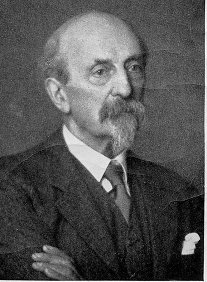 President 1917-1920. Alexander Pelham Trotter (1857-1947) During his long and distinguished career he played many parts. He was apprenticed to Easton & Anderson, took out patents for prismatic glassware, and became a partner in Goolden and Trotter, dynamo manufacturers. This was followed by becoming editor of The Electrician for six years, service as Government electrical engineer for the Cape of Good Hope, then Electrical Advisor to the Board of Trade. After retirement he joined the Consulting Engineers Handcock and Dykes. He had a logical mind
and was keen to try new inventions. He experimented at
Trinity College, Cambridge, with the new Graham Bell
receivers in 1877 (the actual year of the first
published account) and obtained clear though faint
speech across the quadrangle. Later he made his own
wireless receiver at a time when many younger men lacked
the confidence to attempt such novel work.
He
was a Member of the Institution of
Civil Engineers, the Institution of
Electrical Engineers (delivered
the Faraday lecture in 1926), Fellow
of the Physical
Society and other bodies. He was
one of the founder members of the
Illuminating Engineering Society.
Two of his books are considered as classics; “Illumination: Its Distribution and Measurement”(1911) and “The Elements of Illuminating Engineering”(1929). |
|
It was his paper
entitled ‘The Distribution and Measurement of
Illumination” read before the ICE in 1892 that
became the basis for modern illuminating
engineering. This paper
was awarded the Telford Medal and
premium, and described a portable
illumination photometer and its
application to street lighting. At that
time there were no internationally
agreed lighting units it was necessary
to compare the French “carcel-metre”
with the “candle-foot” based upon the
English Parliamentary candle.
Following
the outbreak of the first world war in 1914
Alexander Trotter advised on war-time street
lighting, making observations from a balloon
for the purpose and was made chairman of the
IES Committee, which conducted tests of
parachute flares, etc., for the Department of
Trench Warfare. In 1915 he conducted some
outdoor tests with MacGregor-Morris, Edgcumbe,
Clinton, Blok and Dow in an open space behind
the School of Mines in
Exhibition Road South
Kensington London. Although they had been
given permission by a police officer they
later learned that Woolwich
Arsenal, seeing the illumination of clouds
over South Kensington, thought an enemy raid
had started. As a consequence further tests
were moved out to Tooting Common and
Stonebridge Park. After the war he was
instrumental in the establishment of the
Committee on Illumination Research
operating under Department of Scientific and
Industrial Research. One of Alexander
Trotter’s characteristics was the strong
dislike of official red-tape. He considered
the Physical Society of London represented
the closest approximation to his
ideal scientific society because of its
reduction to a minimum of formalities. In
Who’s Who he listed his recreation as
“remembering that he is no longer a
Government Official’. He spoke French fluently and he and his wife often went to visit M. Blondel in Paris. They had much in common as both had independently developed the dioptric method of distributing light from a source for street lighting. |
|
After
his retirement to Greystones,
Teffont, near Salisbury
Wiltshire, he indulged in his
many hobbies, making
simple scientific toys – mainly
in wood – in his workshop.
He studied the art of printing
and had his own printing press,
which he used to print and bind
poetry written by his wife.
|

 President
1928 -1929 President
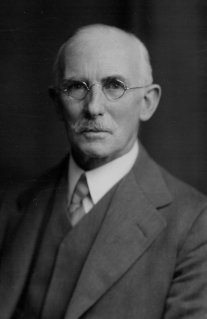
1928 -1929 Sir Clifford Copland Paterson (1879 - 1948) was born in Stoke Newington, son of a tanner and leather merchant. He was educated at Mill Hill School and then trained in general and electrical engineering at Finsbury Technical College and Faraday House. In 1901 he was selected by Richard Glazebrook to join the newly created NPL, where he became responsible for the Electrotechnical and Photometric Departments. He
was awarded an OBE in 1916 for his work on the
Paterson-Walsh aircraft height finder, and in the same
year was approached by Osram Lamp works in Hammersmith
to set up a research department for them (before the
war Osram had depended upon German technology), but he
was not free to accept such a post during the war.
Five days later after the Armistice had been declared
Hugo (later Lord) Hirst asked him to become a founder
director of the GEC research laboratories. Originaly
housed at Hammersmith, 71 staff moved into a purpose
built facility in Wembley in 1922. Work on filament
lamps developed into thermionic valves. Starting with
a small team of five or six, during WWII the staff
grew to more than a thousand and their work on
searchlights, camouflage, radio and radar was to play
a key part in the war effort, rewarded by his
knighthood in 1946. This period of his life is
recorded in "A Scientist's War - The War Diary of Sir
Clifford Paterson 1939 -1945 edited by Clayton and
Algar.
He was President of the IES during 1928 -1929 and the IEE in 1930 -1931, served on Committee's of Department of Scientific and Industrial Research, notable its Lighting of Building report in 1944 which brought the Architectural and Lighting professions closer together. He was appointed to the board of GEC in 1941 and and received his knighthood in 1946. He was awarded Fellowship of The Royal Society, received an Honary Doctorate of Science from Birmingham University. The Gold Medal of IES of North America was presented to his wife on 23rd July only 3 days before his death. The
International Commission set up in 1900 and Paterson
attended as NPL representative in 1907. This became in
the International Commission on Illumination in 1913
and Paterson served as Hon Secretary of from its
formation, and was instrumental in its revival after
the war with the first technical session in Paris in
1921.
Paterson remained Hon Secretary of ICI until his death with only one break when he was its President during 1928 - 31. This period as President culminated with the International Illumination congress in UK with 140 delegates from overseas. It formed the first large scale demonstations of the floodlighting of buildings. His work during the second world war is documented in "A Scientist's War - the War Diary of Sir Clifford Paterson" by Clayton and Alger (ISBN 0 86341 218 1). Apart from his scientific attainments he is remembered for his high principles and human personality to inspire team spirit whilst allowing his staff freedom to work. |
 |
President 1921-23 Born in Bristol he was educated at the University College Bristol and completed at St Bartholomew’s Hospital London. He took a degree in physiology and qualified in medicine. He became ophthalmic surgeon to University College London and the Hospital for Sick Children Great Ormond Street, London. But medical practice was not his first love. He lived for research and clinical ophthalmology was insufficient he needed to investigate the optics together with the perceptual and psychological aspects of vision and sensory perception in their widest sense. |
| President 1932 No
picture found SIR FRANCIS WILLIAM GOODENOUGH CBE 1872 - 1940 Born in Newton Abbot died 11 January aged 67 Married Ellen Roes in 1900 Picture in National Portrait Gallery NPG X84252 Throughout the whole of his career he was associated with the Gas Light and Coke Company of which he became Controller of Gas Sales. For many years he was Executive chairman of British Commercial Gas Association. It was largely through his influence that the service side of the gas industry was developed and its social aspects were so assiduously cultivated. He also served on many government committees and was identified with numerous social and charitable movements. He was a founder member of IES in which he took a keen interest serving on the council and committees before becoming president. He served on the National Illumination Committee and was involved with the organisation of International Illumination /Conference in England in 1931. |
| President 1933 - No picture
found CLEMENT W SULLY, 1870 - 1953 Born in Bridgwater 1870, Somerset, son of George and Mary Sully, died 1953 He was Director of the Electric Lamp manufacturers’ Association from 1923 until his retirement in 1940. His electrical experience began in 1892 when he joined Crompton & Co. Ltd. at Chelmsford. He made many visits overseas and for 12 years represented Siemens Bros. in South Africa. He was responsible for the formation of the Lighting Service Bureau in 1924. |
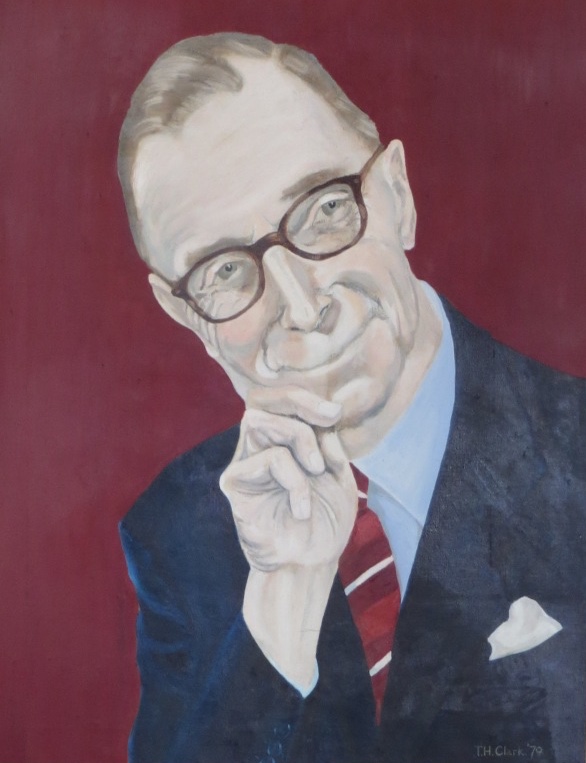 Photo by kind permission of
Malmesbury Town Council
|
|
| President 1941 - No picture
found JOHN TURNER MACGREGOR-MORRIS 1872 - 1959 Professor of Electrical Engineering, University of London 1930 |
 |
|
 |
|
 |
|
|

| President 1976
- No picture found JOHN COLLINS 1918-1990 Started his lighting career at GEC Hirst Research Centre. During the second world war he served in the Admiralty working on searchlights and signal visibility at HMS Vernon. Later he joined the Royal Naval Scientific Service and worked under W D Chesterman and J Y Cousteau on underwater photography. In 1949 he joined Building Research Station to work with R G Hopkinson on daylight and artificial light in buildings, including studies on flicker, visual fatigue and hospital lighting. He was made a Fellow of the Society in 1954 and was vice president from 1971 to 1973. He chaired the Papers Committee in 1969-70, and served on the IES Awards Committee and Technical Committee including the drafting of the 1973 Code, and again in 1975. Between these last two posts he was chairman of the panel considering revision of the IES Glare System. |
back to list


